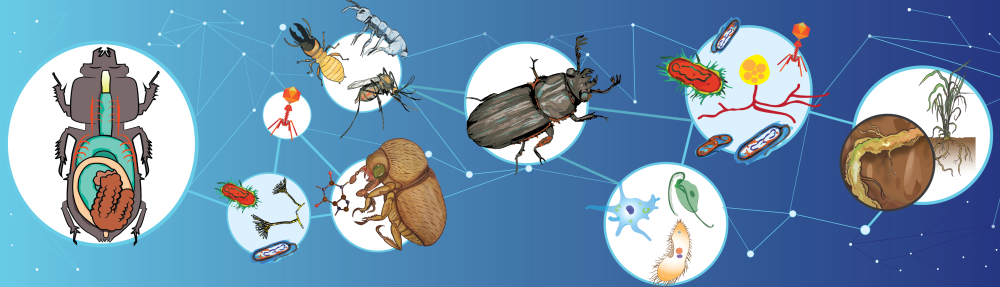
In the Navarro Lab, we study microbial trophic interactions in diverse environmental systems: from insect digestive tracts to the soil rhizosphere, with a focus on nutrient cycling and ecosystem function.
Ciliates, flagellates, and amoebae hunt bacteria and archaea in soil
Our research focuses on the complexity of environmental and host-associated microbiomes, including viruses, bacteria, archaea, fungi, and protists. We study how microbial communities are structured, how they respond to environmental change, and how their activities influence nutrient cycling, carbon flow, host physiology, and ecosystem functioning.
Because microbial systems are highly complex, our work integrates multiple approaches. We combine chemical analyses, traditional microbiology, microbial isolation, experimental manipulations, and molecular tools such as metabarcoding, metagenomics, and metatranscriptomics. We also use bioinformatics, network analysis, and other computational approaches to process and interpret large multi-omics datasets and to identify relationships among environmental conditions, microbial interactions, and biological function.
Our research spans both host-associated and environmental systems, with an emphasis on microbial interactions that shape ecological and evolutionary outcomes.
Current areas of study include:
The coffee berry borer and its detoxifying microbiome
We study the association between the coffee berry borer and its gut microbiome, with a focus on how microbial partners contribute to the degradation of toxic plant alkaloids such as caffeine. This work examines how insect-associated microbes influence host adaptation, nutrition, and survival in chemically defended environments.
Rhizosphere microbial interactions and nutrient cycling
We investigate the rhizosphere microbiomes of different plant species and examine how multitrophic microbial interactions among bacteria, fungi, protists, archaea, and viruses influence nutrient cycling and plant-associated ecosystem processes.
Soil retrogression and microbial biodiversity
Using the Jughandle Chronosequence in Mendocino, California, we study how long-term ecosystem development and soil retrogression shape microbial biodiversity across domains, from bacteria and archaea to fungi and protists. This work explores how microbial communities and their functional potential respond to long-term nutrient limitation.
Microbial lignin degradation using insect microbiomes
We examine the capacity of insect-associated microbiomes to degrade and transform lignin and other complex plant polymers. This research explores how microbial communities from insect systems may contribute to carbon transformation and the breakdown of recalcitrant organic matter.
Microbial predator-prey interactions and ecosystem function
We study predator-prey interactions among microbes, particularly the role of protists and other microbial predators in restructuring microbial communities. This work focuses on how microbial predation influences nutrient cycling, microbial activity, and the expression of functional genes involved in ecosystem processes.
Together, our research seeks to understand how microbial interactions, from host-associated symbioses to environmental multitrophic networks, regulate biological function across scales, from genes and communities to hosts and ecosystems.

